The Siege of Cadiz, part 4

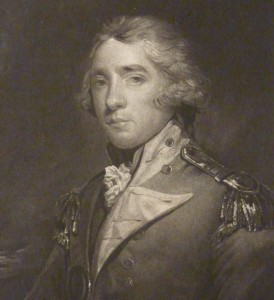
General Thomas Graham
By January 1811 Cadiz had been under siege for nearly a year. Within the city the situation had been sufficiently secure for the newly elected National Cortes to meet in September. On the mainland the French remained frustrated by the geography of the isthmus and the presence of British and Spanish naval forces which prevented them from getting any nearer to taking the city. To make matters worse, Marshal Victor had received no support from Marshal Soult, who had given him the task of taking Cadiz. And now, at the beginning of a new year, Soult had not only diverted his attention to Badajoz but had also deprived Victor of an infantry regiment and most of his cavalry. As General Graham appreciated, the French had little hope of taking Cadiz without first reinforcing Victor.
Graham reported to Wellington on the 15th January:
The information received yesterday morning by the Spanish Government of the reduced force of the enemy before this place has determined the General to make an attempt to drive him from his position.
The General in question was Manuel La Peña, a plausible talker but a man who shirked responsibility and lacked decisiveness [Oman]. He was popularly known as Doña Manuela. Nevertheless, Graham was prepared to accept his command because any Spanish contribution to an allied operation would be larger than the British contingent (8,000 Spanish to 5,000 British).
The plan was to land on the coast away from the Isla and draw Victor away from his lines, which could then be attacked by the Cadiz garrison. There were also 1,600 irregulars operating in the Ronda mountains who could be drawn down to disrupt Victor’s communications.
On the 21st February Graham wrote to the Earl of Liverpool (the prime minister):
I have the honour to inform your Lordship that an expedition is now embarked and ready to sail. The allied troops composing it are under the command of General Lapena [sic], the interim Commander-in-Chief of the army here. I go myself in command of the British Division, leaving Major-General Disney in the command of our forces here.
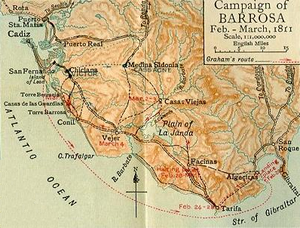
The same day the British force (which included two Portuguese light companies) sailed to Gibraltar and three days later reached Tarifa, picking up more men in both places. The Spanish arrived on the 26th and 27th. Once La Peña had landed, on the 27th, the expedition could begin. The next day the British set off at 8.45am and reached Puente de Foscinas five hours later. Graham recorded in his diary that progress was better than expected, the roads having been repaired and improved. But the Spaniards did not arrive until late in the evening.
La Peña now had to choose between two routes: a coastal track which would take them to Vejer de la Frontera, Conil and Chiclana, this last being close to French headquarters, and an inland route which would bring them to Casa Viejas and Medina Sidonia. Following the latter route would enable them to pursue their original strategy, which was to draw Victor away from Cadiz.
La Peña chose the inland route, which was satisfactory, but he refused to set out until night, which left Graham seriously disgruntled. His diary records:
Marched in the evening – very tedious from filing across water and other difficulties. Misled by the guides in quitting the Cortigo de la Javas, and counter-marching made a most fatiguing march…It was 12 o’clock before the troops halted, having been 19 hours under arms.
The first French position on their route was at Casa Viejas, which La Peña chose to ignore, but the French fled anyway. Some prisoners were taken and reported a strong French presence at Medina Sidonia, 3,000 men under General Cassagne, whereupon La Peña announced a complete change of plan. (He obviously reckoned that odds of over four to one were not sufficient to guarantee victory!) He decided that they should avoid Medina Sidonia. Instead, they would take a bridle path to Vejer de la Frontera in order to join the coastal route, and he was not to be dissuaded, even when Graham pointed out that the path was flooded.
As Graham confided to his journal:
Marched in same order (reserve always in rear) about 8. Guides mistook the road, and were leading the column back towards Foscinas, to leave the lake [Lake Janda] on our right. Counter-marched, and crossed the plain to a flooded causeway across the Barboté; the passage lasted three hours, and would have taken double the time but for the exertions made to force them to keep the files connected. Set the example of going into the water, which was followed by Lacy, Prince Anglona, and others. Did not reach the ground to encamp on, near Vejer, till near 12 at night – 3 leagues, 15 to 16 hours.
Meanwhile, Victor was confused by contradictory reports. A squadron of French dragoons which had been driven out of Vejer reported the presence of the allies there but Cassagne, in Medina Sidonia, sent messages that they were at Casa Viejas. This dilemma was resolved when Victor realised that the bridge which General Zayas had built across the Santi Petri during the night of the 2nd/3rd March was designed to enable the allied force to make contact with Cadiz from Vejer. The position had already been stormed by French voltigeurs and the defenders cut to pieces, although the bridge itself remained intact.
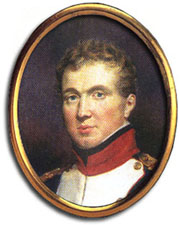
Marshal Victor
Victor now placed his troops accordingly. General Villatte was to block the neck of the peninsula along the Vejer and Conil road leading to the Santi Petri creek. Ruffin and Laval were to wait on allied moves in response to Villatte’s position. Victor expected them to make a flankwise attack on the allies between Villatte’s position and Barossa hill. And Cassagne was to bring his forces down from Medina Sidonia in support.
On the 4th March Ruffin and Laval were at Chiclana and Villatte was on the ridge at Torre Berjema, while the allies were marching towards Conil and then onto the beach track for Santi Petri. A collision of forces was inevitable, and this was to come about at the Battle of Barossa.
_______________________________________________________