The Education of Officers for Wellington’s army
In 1812 The Royal Military Chronicle published a letter on the subject of Military Education and Schools. The writer, who signed himself as St Philip, noted to the editors that
‘In your first lecture to the Gentlemen of the army, you have observed, that, from the want of any general school for military instruction in England, the officers enter the army without any military knowledge whatever; whereas in France they receive a course of military instruction, acquire a stock of knowledge, which, improved by one or two practical campaigns, completes them in the art of war, which I must perfectly agree in, and lament the truth of your observation.’
Although the writer conceded that ‘military schools have been established in this country for the educations of gentlemen intended for the army’, he did not believe that such establishments would enable their students to become ‘masters in the art of war’. In his opinion, the subjects taught, mathematics, fortification, drawing, writing, arithmetic, and geography, provided insufficient preparation. He instanced ‘general information of distinguished military characters’, history and topographical knowledge as missing elements. He also stressed the need for the officer to be acquainted with ‘both men and manners’, which suggests that gentlemen was as significant a term as officer.
By the time St Philip wrote his letter, the Royal Military College at High Wycombe had been in existence for more than a decade. The establishment was the brainchild of Lieutenant Colonel (later major General) John Gaspard Le Marchant, who in January 1799 presented the idea of ‘the establishment of a Military College for the education of persons intended for the land service, which also comprised a course of instruction for officers intended to serve on the General Staff.’
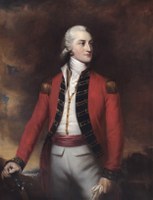
Lieutenant Colonel (later major General) John Gaspard Le Marchant
When the Royal Military College was opened to the first students, Le Marchant became lieutenant-general and superintendant general, while a French émigré officer, General Jarry, was the first inspector-general. Jarry spoke only French and was regarded was eccentric but had distinguished himself as a staff officer with the French Army of the North in 1792. His Instructions for the Light Infantry in the Field proved seminal.
The effects of the staff education offered at High Wycombe took time to be recognised. Indeed, Wellington, in the Peninsula, was still of the opinion that ‘family, fortune and influence’ were preferable to the ‘coxcombs and pedants’ produced by the college. Nevertheless, he managed to work as successfully with the thirty-four graduates of High Wycombe who served on his staff as with the men whose circumstances were more to his liking.
The college acquired a junior department in 1802, which was established at Marlow, before being moved to Sandhurst in 1811. As the original regulations stated: ‘His Majesty, in consideration of the many and very essential advantages to be derived from the establishment of an institution for the purpose of affording a regular military education to those who may from an early life be intended for the military profession, and who by these means may be grounded in science previous to their attaining the age that enables them, consistently with his Majesty’s regulations, to hold commissions in the army, [has] been pleased to establish an institution under the title of The Royal Military College.’ It was always intended that Marlow should be a temporary location, but the commissioners were able to announce that ‘a commodious house and premises have been taken, and are now nearly ready for the reception of one hundred gentlemen cadets, who are to be formed into a company, and to be called the first company of the junior department.’
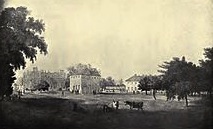
Royal Military College Marlow, 1810
Further details were appended, setting out ‘leading rules, orders, and regulations for said department.
‘The cadets are to be received upon three different establishments, viz.
30, the sons of officers, who have died or been maimed in his Majesty’s service:
These are to receive their education, board and clothing free from expense.
20, the sons of officers actually in his Majesty’s service:
These are to pay 40l. per annum each, for which they are to receive their education, board and clothing.
30, the sons of noblemen and gentlemen, and 20, the cadets of the East India Company service:
These are to pay 90 guineas per annum each, for which they are to receive their education, board, and clothing.
Linen is not included.
No cadet to be admitted who is under thirteen or above fifteen years of age, or who has any mental or bodily defect which may disqualify him for military service. He is to produce a satisfactory certificate of the time of his birth.
Every candidate for admission is to be well grounded in a knowledge of grammar and common arithmetic; he is also to write a good legible hand…
The cadets will be formed into a military body, and be instructed in languages and the military sciences and duties, by professors and masters of approved abilities. The cadets of the East India Company will likewise be instructed in the Oriental languages.
Public examinations will be held for the purpose of ascertaining progress and improvement; and no cadet will be recommended from the college for a commission until he has undergone a public examination, and has received a certificate as to his sufficiency.
No cadet can remain longer than four years.
The health and morals of the cadets will be strictly attended to, and habits of temperance and œconomy strongly inculcated.’
As already noted, not everyone in the military establishment was in favour of this form of officer preparation, while the small number of cadets (320 by 1809) meant that the influence of the Royal Military College was slow to take effect. Nevertheless, T.J., in a long letter written in 1811 On Military Education, recognised that ‘Marlow and Wycombe are rapidly effecting a very desirable change [to the lack of acquirements which every gentleman would wish to possess, and of branches of knowledge which are more immediately connected with a military life] not only by the numerous accomplished officers which they produce, but the desire of knowledge which has thereby been disseminated through the army. Officers, even of the rank of lieutenant-colonel, feeling the deficiency of their first education, return to school to make themselves masters of subjects which greatly increase their value and importance, and open for them a shorter and more splendid road to preferment and distinction.’
The early 19th Century British army was innately conservative, and it would be many decades before the desirability of educating all potential officers for their future career was generally accepted. The inspiration of John Le Marchant, however, served to open the debate.
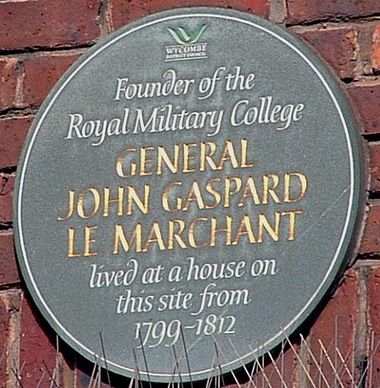
Memorial plaque to Le Marchant
_____________________________