The Siege of Cadiz, part 5
The Battle of Barossa, 5th March 1811
After an abortive march inland (see last month’s article), the combined Anglo-Spanish force, under the command of General La Peña, was following a coastal route back towards Cadiz, to link up with the small force of General Zayas, operating from Cadiz. The first attempt by Zayas to build a pontoon bridge and attack the French from the rear had been thwarted when Victor attacked the tête-du-pont at Santi Petri on the night of the 3rd March. Zayas, however, had been able to save the pontoons, keeping them on the Isla.
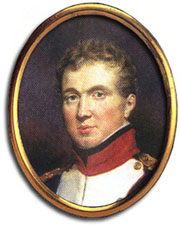
Marshal Victor
Now, as the Spanish, leading the allied forces, came into contact with Villatte, who had been ordered to block the coast road, Zayas used the pontoons to launch an attack on the French from the rear.
Villatte received the worst of two Spanish attacks and promptly withdrew northwards to defend the crossing point of the Almanza creek, in accordance with orders from Victor. Lardizabal, leading the Spanish force, was eager to pursue the retreating French but was restrained by La Peña. The Spanish General had attained his objective, which was to re-establish contact with Cadiz.
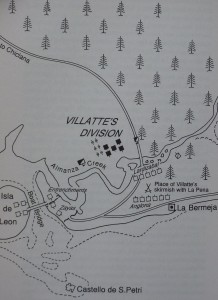
Villatte’s position by the Almanza Creek
This first action had taken place at about 9 a.m. Towards midday La Peña ordered Graham to abandon the Barossa heights and advance towards the Almanza creek. His place was to be taken on the heights by Cruz Murgeon with two attached Spanish battalions, Beguines’ irregulars and Whittingham’s four squadrons of Spanish cavalry.
Graham had already pointed out the importance of the heights to La Peña. He recognised that if they were now abandoned, Victor would seize the position using the forces of Ruffin and Leval and would then be able to attack the allies from the rear and drive them back into Cadiz. La Peña, however, did not want the allied forces extended over four miles.
Reluctantly, Graham complied with the order, leaving Browne’s battalion (2 companies each of the 9th, 28th and 2/82nd) to cover his withdrawal as the Spanish took up position on the heights. Unable to see clearly what was happening, Victor nevertheless decided to send Ruffin and Leval to seize the heights and then fall on the allies. Their rapid arrival caused the Spanish to abandon the position. Browne was reluctant to join them but, recognising that his situation was hopeless, set off to warn Graham.
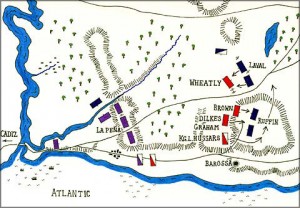
Plan of the battle of Barossa
Graham subsequently wrote in his report to Lord Liverpool, the prime minister:
“My division being halted on the eastern slope of the Barossa height, was marched about 12 o’clock through the wood towards Berjema…On the march I received notice that the enemy had appeared in force on the plain, and was advancing towards the heights of Barossa.
“As I considered that position as the key to that of Santi Petri, I immediately counter-marched, in order to support the troops left for its defence, and the alacrity with which this manoeuvre was executed served as a favourable omen. It was, however, impossible in such intricate and difficult ground to preserve order in column, and there never was time to restore it entirely.
“But before we could get ourselves quite disentangled from the woods, the troops on the Barossa hill were seen returning from it, while the enemy’s left wing [Ruffin] was rapidly ascending. At the same time his right wing [Leval] stood on the plain on the edge of the wood, within cannon-shot.”
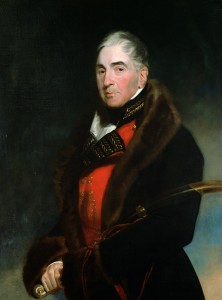
General Graham
Graham decided upon an immediate attack.
“Major Duncan soon opened a powerful batttery of ten guns in the centre; Brigadier-General Dilkes, with the brigade of Guards, Lieutenant-Colonel Browne’s flank battalion, Colonel Norcott’s two companies of the 2nd Rifle Corps, and Major Acheson, with a part of the 67th foot…formed on the right.
“Colonel Wheatley’s brigade [28th, 2/67th, 2/87th] with three companies of the Coldstream Guards…and Lieutenant-Colonel Barnard’s flank battalion [4 companies 3/95th, 2 companied 2/47th] formed on the left.
“…The right wing proceeded to the attack of General Ruffin’s division on the hill, while Lieutenant-Colonel Barnard’s flank battalion and Lieutenant-Colonel Bushe’s detachment of the 20th Portuguese were warmly engaged with the tirailleurs on our left.
“General Laval’s division, notwithstanding the havoc made by Major Duncan’s battery, continued to advance in very imposing masses, opening his fire of musketry, and was only checked by that of the left wing; a most determined charge by the three companies of Guards and the 87th Regiment, supported by all the remainder of the wing, decided the defeat of General Leval’s division.
“The eagle of the 8th Regiment of Light Infantry, which suffered immensely, and a howitzer rewarded this charge…
“A reserve formed beyond the narrow valley, across which the enemy was closely pursued, next shared the same fate and was routed by the same means.
“Meanwhile, the right wing was not less successful. The enemy, confident of success, met General Dilkes on the ascent of the hill, and the contest was sanguinary; but the undaunted perseverance of the brigade of Guards, of Lieutenant-Colonel Browne’s battalion, and of Lieutenant-Colonel Norcott’s and Major Acheson’s detachment overcame every obstacle, and General Ruffin’s division was driven from the heights in confusion, leaving two pieces of cannon.
“No expression of mine could do justice to the conduct of the troops throughout…In less than an hour and a half from the commencement of the action the enemy was in full retreat…”
Graham also praised Cruz Murgeon’s battalions, “who made every effort to come back in time when it was known that we were engaged.” Also, “One squadron of the 2nd Hussars, King’s German Legion, under Captain Busche…joined in time to make a brilliant and most successful charge against a squadron of French dragoons, who were entirely routed.”
The eagle of the 8th was the first to be taken in action by British forces. Initially seized by Ensign Keogh of the 2/87th, who was killed in the struggle which followed, it was then retaken by Sergeant Masterman, who is said to have announced to his comrades: “I’ve got cuckoo boys!”
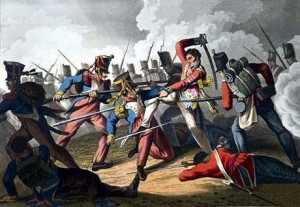
Sergeant Masterman of the 87th Foot takes the eagle of 8eme de la Ligne.
Graham’s measured account, while making clear what happened, does not convey the desperate nature of the battle. Because he could only feed in his forces piecemeal. they were frequently fighting against considerable odds. Yet ultimately it was the steadiness of British musketry and the determination of the men themselves which won the day.
As for La Peña, although he was only two miles from Wheatley’s position, and three from the heights, he was so sure the British would be defeated that he chose to give no support and refused the pleas of General Zayas either to help the British or create a diversion by attacking Villatte. Even when victory was certain, he claimed his troops were too tired to launch a pursuit of the fleeing French.
Graham’s force: 236 officers and 4981 men
Victor’s force engaged at Barossa: 238 officers and 6932 men
Graham’s losses: 6 officers and 195 men killed, 51 officers and 986 men wounded (total: 1238)
Victor’s losses: 24 officers and 220 men killed, 54 officers and 1630 men wounded, 10 officers and 124 men missing (total: 2026)
[All figures from Oman]
(Next I shall look at the repercussions of Barossa and publish the article here on the 1st April.)
_______________________________________