Some Unexpected Advice to the Military

Frontispiece from the 1806 edition of Captain Grose’s book.
In 1782 Captain Francis Grose, an antiquary, anonymously published his “Advice to the Officers of the British Army, a Satire”, a work which seems to have caught the mood of the times. There were several reprints and in 1806 the title was expanded to “…Officers of the British and Irish Armies, with the addition of some Hints to the Drummer and the Private Soldier.” The initial edition, with its caustic view of the officers of the day, would have been read in the context of the War of American Independence. The 1806 edition probably provoked a similar response. After all, despite some success in Egypt (1801), the army had achieved little against the French since 1793.
Like all the best satire, Grose’s work exaggerated what would be recognised as the worst features of the army and then turned them into everything that was desirable, using the style that was common to many genuine books of advice of the time. Indeed, as he wrote in his introduction: “As the world in general does not seem to have become more wise or virtuous, in consequence of the numberless volumes that have been written for their instruction and improvement; so it does not appear that the different military publications within this last centuryhave added either to the knowledge or capacity of our generals, or to the good conduct or discipline of our armies. Convinced as we are, then, of the futility of all former attempts, why enter on a fresh one?”
Grose answered his own question, claiming that “he has discovered the sole reason why other advisers have been so little attended to: namely, because they have laid down a line of conduct in direct opposition to the inclination of their readers.” Consequently, his advice would be framed to give his readers whated they want to hear and, for that reason, it would be attended to.
Not surprisingly, Grose began by addressing the senior officers of the army, and a selection of the advice he offered them will be the focus of this article. (Junior officers and rank and file will form the focus of future articles.)
Starting with “General Officers, commanding in chief”, he reminded them that they are “what the soul is to the body” and for that reason “You must, therefore, through good will and affection for your troops, take care of your own sacred person, and never expose it to any dangers…When any service of danger is to be performed you should send your second in command, or some inferior officer – but whomsoever you send, if he succeeds in the business, be sure to take all the merit of it to yourself.”
Furthermore, “You have heard that secrecy is one of the first requisites in a commander. In order, therefore, to get a name for this great military virtue, you must always be silent and sullen…Ignorance of your profession is best concealed by solemnity and silence, which pass for profound knowledge upon the generality of mankind. A proper attention to these, together with extreme severity, will soon procure you the character of a good officer.”
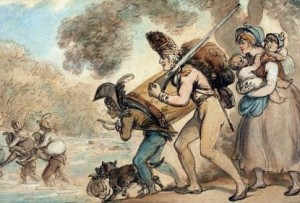
A contemporary Rowlandson print showing a somewhat jaundiced view of the military
Nepotism was undoubtedly a desirable practice and the commander in chief “must take care never to advance an officer above one step at a time, however brilliant his merit, unless he be your relation… As you probably did not rise to your present distinguished rank by your own merit it cannot reasonably be expected that you should promote others on that score. Above all, be careful never to promote an intelligent fellow; a brave, chuckle-headed fellow will do full as well to execute your orders.”
When it came to action, the commander in chief should show generosity to the enemy. “To follow up a victory would be taking the advantage of his distress.” Similarly, “You should always act openly and fairly with friends and foes. Never therefore steal a march, or lay in ambush; neither should you fire upon or attack your enemy in the night.”
At the conclusion of his career, the commanding officer should “get the command of a camp or district in old England, where you may enjoy all the parade and pomp of war, and, at the same time, be tolerably secure from those hard knocks, which your necessities impelled you to risk in your younger days.”
As for “Colonels and Lieutenant-Colonels commanding Corps”, “As soon as you have arrived at the command of a regiment, you will form your conduct upon the model of your superiors, and be as despotic in your little department as the great Cham of Tartary…You are to consider yourself as the father of your corps, and must take care to exercise a paternal care over it: as a good father does not spare the rod, so should a commanding officer not spare the cat-of-nine-tails.”
“When promoted to the command of a regiment from some other corps, shew [sic] them that they were all in the dark before, and, overturning their whole routine of discipline, introduce another as different as possible…”
Subalterns, who actually dare to think of themselves as gentlemen, should be put upon “the most disagreeable and ungentlemanly duties,” while a colonel should “never speak kindly to a non-commission officer.” Indeed, the first duty of a colonel was to consider himself above all others in the regiment: “though your education may have been confined to reading, writing, and the four first rules of Arithmetik [sic], yet you are to consider every man as an ignorant and illiterate fellow, who knows not how to manoeuvre a battalion.”
If senior officers followed this guidance, success was assured!
______________________________________