The Royal Military Chronicle
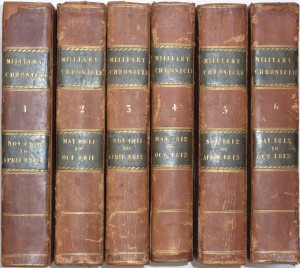
The six volumes
The Royal Military Chronicle, or to give its alternative title British Officer’s Monthly Register, Chronicle and Military Mentor, is of particular interest to students of the Napoleonic Wars because it was written for officers by offi cers. Thus it reflects the concerns and interests of British officers during the Peninsular War.
The Chronicle first appeared in November 1810, following the publication of a prospectus. It was a substantial publication, 86 octavo pages printed in 10-point font. The contents of this first edition are typical of what was to follow: the first part of “The Life of Lord Wellington” with an aappropriate portrait; “Journal of the Present Operations in Portugal”, illlustrated by a map of Beira and much topographical description; “The Present State and Economy of the Armies of Europe”, focusing in this issue on the Portuguese army; “Battle of Busaco”, with particular emphasis on the strategic implications of the action; “Course of Tactics, as taught in the polytechnic school of France. Lecture the First”, with an introduction by the editor which excused the use of the first person, a stylistic faux pas justified by the expertise of “the Gentleman to whom we owe them”; “The Law and Practice of Courts Martial” part one; “Topographical Accounts of Garrisons, &c, Malta, Oct. 2, 1810”, in the form of a letter; “Military Correspondence”; and “Military Chronicle, Containing the Gazettes at full length, Promotions, Orders, and Military Miscellaneous Occurrences of every kind.”
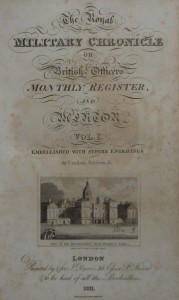
The title page of volume 1, published 1811
Such a range of contents makes clear there was a presupposition that officers would be interested not just in the business of their duty, as illustrated by the sections on tactics and courts martial, but also in the state of affairs in Europe, particularly in the Peninsula, and in the lives of successful senior officers. Furthermore, the readers themselves were invited to contribute. As the proprietors wrote in this first issue: “The Gentlemen of the Army will be perfectly aware, that this work can never be so complete as they and ourselves must wish, unless they will themselves contribute towards it. Every information relating to military affairs and concerns, whether general or regimental, will be thankfully received, and inserted in any form which the writer may desire.”
The first issue contained only two letters, one an officer’s pensees militaires, the other from H, an officer in the Norfolk district. Having posed the question, “Has any period of the English history ever occurred, in which the country is more indebted to the British army?”, he described how inappropriately officers were treated by the local gentry. From his own experience, he was aware on the “marked indifference” or even “something as nearly approaching to personal disrespect, as their courage will let them”. This is the first indication of how officers came increasingly to use the Chronicle as a means of expressing grievances.
By the second issue, the matter of pay (in this case the insufficiency of half-pay) had made its appearance. In subsequent issues the other concern which particularly occupied the thoughts of officers, the vexed matter of promotion, became increasingly a subject for letter-writing. Self-interest was not the only focus of the letters, however. There was much written about military duties, the importance of military education, and even how to make “the military profession more popular among the lower orders of people”.
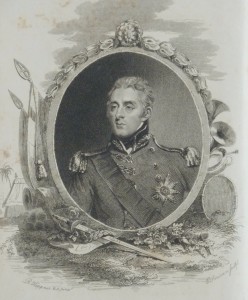
A portrait of the Rt. Honourable Lord Wellington (volume 1, 1811)
The scope of the lectures also broadened to include, for example, practical engineering, strategy, instructions for commanders of detachments, and regimental histories, while the military biographies included not only British generals and lieutenant-colonels but also French marshals. Some historical campaigns were revisited, and the number of eye-witness accounts steadily increased.
For the British officer The Royal Military Chronicle was a valuable publication which gave him a voice, reflected his concerns, kept him up to date by including the gazettes, and (in some cases) gave him valuable information about the knowledge required of an officer if he was to perform his duty appropriately.
____________________________________