The Royal Military Asylum, Chelsea
On the 19th June, 1801, the Duke of York, Commander in Chief of the Army, laid the first stone for new institution, the Royal Militry Asylum for the children of soldiers of the regular army, on a site near the Royal Hospital, Chelsea. As the Royal Military Chronicle commented in an article eleven years later:
“The motives which gave rise to the establishment, and the principles upon which it is founded, are alike honourable to the present enlightened age, and congenial with the soundest maxims of policy, humanity, and benevolence.”
The Royal Military Asylum was not, however, the first institution to offer a refuge to the orphaned children of soldiers. The Royal Hibernian Military School had been established in Dublin in 1765, and was the model for its London counterpart. When the Duke of York conceived the new institution, he based his ideas on the already existing military school. On a more humanitarian level, he was inspired to do something for these orphaned children by the sheer number that eight years of war had produced.
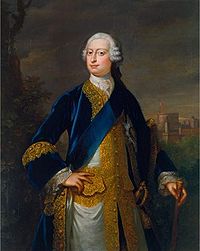
Frederick, Duke of York
The Asylum was run on military lines with military appointees in charge: commandant, adjutant, chaplain, quartermaster, surgeon, assistant surgeon, and matron. In addition, there was a sergeant major of instructions who, with his assistants, supervised the education of the boys, while the matron, with her assistants, did the same for the girls. The affairs of the Asylum were regulated by commissioners, appointed by the King, and they also selected the children (originally 700 boys and 300 girls) who should be admitted as pupils. Some would come automatically from an establishment on the Isle of Wight for children who were considered too young for the Asylum.
These children were the legitimate offspring of soldiers who had been killed, or died while serving abroad, or whose mothers had died and whose fathers were serving abroad, or whose fathers had been ordered on foreign service, or whose parents had other children to maintain. The character of the father, whether dead or still living, was crucially imporatnt. For this reason, once the child’s parent or guardian had made the initial application, giving full details of the child’s situation, the commanding officer of the father’s regiment had to vouch for the soldier’s good conduct. In addition, the parents’ marriage certificate and the child’s birth and baptismal certificate had to be supplied, as well as a certificate of health, from the regimental surgeon or a recognised medical practitioner.
Once the children were accepted, on the understanding that they would stay for as long as the commissioners considered desirable, they wore the red and blue uniform of the Asylum: red jacket, blue breeches, blue stockings and black cap for boys; red gown, blue petticoat, white apron, straw bonnet for girls. They also followed a strictly regulated day.
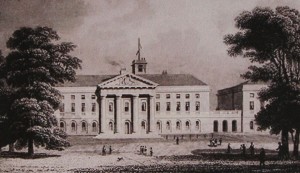
The Royal Military Asylum, Chelsea
The children were woken by the beat of a drum, at six o’clock in the summer and seven o’clock in the winter. They had two hours to clean boots and shoes, wash their face and hands, and generally put their dormitories to rights, before breakfast at eight o’clock in the summer and nine o’clock in the winter. Breakfast consisted of milk pottage, made of 1/6th quart of milk and 1/10th pound of oatmeal per child, and 1/20th of a quartern loaf. The school day started with prayers read either by the chaplain or by the sergeant major of instruction (to the boys) and the matron (to the girls). Lessons then followed, reading and writing and the first four rules of arithmetic so that the children could cast accounts. Dinner was at one o’clock, and allowed some variation. For example, on three days the children were given eight ounces of beef, roasted, stewed or boiled, with twelve ounces of potatoes, 1/40th of a quartern loaf, and half a pint of beer. This was varied with boiled mutton, suet pudding, or pea soup, and milk rather than beer. Lessons recommenced at half past two, until five, followed by supper at seven o’clock in the summer and six o’clock in the winter. This meal consisted either of cheese, bread and beer, or bread and milk. There were also periods of play fitted into the timetable, although the girls were required to perform household duties, in which they were given specific instruction, and the boys were drilled.
Since moral education was also considered crucially important, the chaplain taught the children their catechism and gave them religious instruction.
It was hoped that the boys would choose to enlist in the regular army, although those who did not were given training that would prepare them for an apprenticeship. The girls were also trained for apprenticeships or for employment as servants.
Although this may seem a very regimented existence by today’s standards, it is important to remember that the parents of many of these children came from the lowest levels of society. The education they received from the Royal Military Asylum undoubtedly prepared them for a future which offered more opportunity than their parents would have experienced.
As the Royal Military Chronicle concluded:
“To the soldier, it must continually afford the most pleasing prospects for the comfort and support of his infant children, and will induce him to fight, if possible, with greater confidence and energy; at least, it will incite him to enter the field against the enemies of his king and country, with a full and complete assurance that, if he falls in battle, his family will never feel the pangs of misery, famine, or want; there indeed can exist but one opinion of the utility and necessity of such an institution as the Royal Military Asylum for the children of soldiers of the regular army, which appears to have entirely realized the benevolent intentions of the original projectors.”
1. The Royal Military Chronicle Volume III p.242
2. Ibid p.249
___________________________________________