General Graham, a most unusual soldier
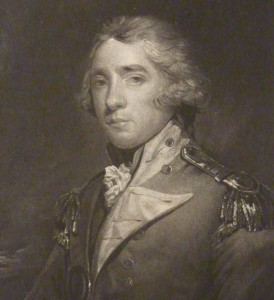
Sir Thomas Graham, an 1800 portrait by Hoppner.
When Thomas Graham was born in 1748, no-one would have been likely to predict that just over sixty years later he would arrive in Cadiz as commander of the British troops who had arrived at the request of the Spanish to aid in the defence of the besieged city.
Son of a Scottish landowner, Graham became the 7th Laird of Balgowan while still in his teens. Except for an accident of fate he would have spent his life as a Whig MP, agriculturalist, traveller and keen sportsman, and would probably have been best remembered for taking part in the first recorded cricket match to be played in Scotland.
In 1774 he married Mary, a daughter of the 9th Lord Cathcart, a woman who was immortalised as “the beautiful Mrs Graham” in the famous portrait by Gainsborough. The marriage, a love-match, was blissfully happy, but a shadow hung over it. Mary’s family was consumptive. Tuberculosis killed both her parents and four of her siblings.

The Hon. Mrs Graham
By 1792 it was obvious that Mary was suffering from the disease, and in desperation Graham took her to Nice, in the hope that a kinder climate would effect a recovery. There was no improvement, however. Mary, knowing that she was dying, wanted only to return to Scotland. They sailed to Hyeres, from where it would be possible to travel across France by the canal system, and then sail on to Scotland.
Even as Graham was making arrangements for their journey, Mary died. The grieving widower, accompanied by his young sister-in-law, set out on the journey he had planned for his wife. At the mouth of the Toulouse canal officials demanded that he open the coffin, claiming that he was using it for smuggling activities.
On this occasion, he was fortunate enough to win the sympathy of the local Director of Customs, who gave him a pass for the rest of the journey across France. The country, however, was sinking into the anarchy which would culminate in the Reign of Terror. At the last lock where the canal joined the Garonne, a group of drunken National Guards, supported by a mob of Volunteers, insisted upon opening the coffin. When Graham tried to stop them, he was attacked.
As he wrote in his journal,
“At first I attempted to interfere by advice and entreaties as to the manner of opening it; but this only irritated them to more brutality, and I got as near the other end of the boat as possible and remained almost suffocated with horror and rage…”
Eventually, Graham returned to Balgowan and buried his wife, as she had wished, in her homeland. Devastated by Mary’s death, however, he could not return to his old life. He was persuaded by his cousin, the Honourable John Hope (General Hope of Peninsular fame) to accompany him on a journey to mainland Europe which took them to Gibraltar. Here Graham was advised by General Sir John Moore (a fellow Whig whom Graham greatly admired) to travel to Toulon, where the Royalists had risen against the extremes of Jacobinism.
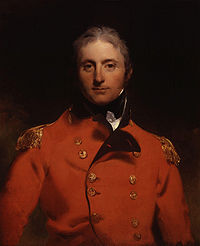
Sir John Moore, portait by Sir Thomas Lawrence
For a man who had become an inveterate enemy of the French Revolution, this was an opportunity to both exorcise his grief and, possibly, play some part in the overthrow of that revolution.
In the first instance, he went as an observer, but he was unable to resist the invitation to act as unofficial aide-de-camp to Lord Mulgrave, in command of the British land forces in Toulon. Thus, at the age of 45, Graham discovered both a taste and a talent for the business of soldiering.
After the fall of Toulon at the end of 1793, Graham returned to Scotland where he raised the 90th (Perthshire Volunteer) Regiment at his own expense – to the horror of his somewhat penny-pinching mother. Perhaps she was right to be alarmed, because it took all her son’s money!
Although Graham was Colonel of his own regiment, he held no official rank in the British army. Nevertheless, he continued to pursue his military activities, serving with the Austrian army in North Italy in 1796, and fulfiling various functions in Minorca (1797), Naples (1798), Malta (1799), Egypt (1801) – where he had been refused permission to command his own regiment, – Sweden (1808) and the Peninsula (1809). These last two expeditions had seen him as volunteer aide-de-camp to Moore, his close friend.
Throughout this period, Graham had been petitioning for a permanent position within the army, but had been thwarted by the Duke of York, who insisted he must serve at a lower rank than colonel. In March 1809, however, Graham received what he so long desired.
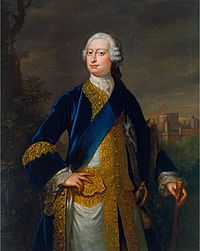
Frederick, Duke of York
The Duke of York wrote:
“…I have not failed to submit to the King the communication made to me by Lieutenant-General the Hon. John Hope at the dying request of the late Lieut-General Sir John Moore, upon the subject of the eminent and important services performed by you during the campaign in Spain; and His Majesty in consideration of the earnest and last solicitation of that gallant officer, and in testimony of the zeal which you have upon several occasions manifested for His Majesty’s service, has been graciously pleased to direct that, in your particular case, the established custom of the army may be departed from by your being promoted to the rank of Major-General…”
As Major-General, therefore, Graham took part in the Walcheren expedition of 1809, one of the few senior officers to emerge with any credit from that mismanaged campaign.
At the beginning of 1810, Graham received tacit testimony to his abilities when Wellington named him as one of only three general officers he would be happy to accept as a replacement for the ailing General Sherbrooke. But instead of sailing to Portugal, where Wellington was close to starving Massena out of Portugal, Graham found himself directed to Cadiz where he would be responsible for co-operating with the Spanish.
This appointment was no accident. Graham was not only a more than competent linguist; he had already proved that he had the rare gift of adapting his own attitudes to those with other cultural and political traditions.
At this point, one can do no better than refer to the opinion of Oman, who described the 62-year-old Scotsman as possessed of:
“indomitable resolution, swift decision, a good eye for topography, the power of inspiring enthusiastic confidence in his troops.”
He would need all these qualities in the coming months; but
“He was no mere professional soldier, but a crusader with a mission.”
In Cadiz he would be able to pursue his personal crusade against the legacy of that anarchy he had witnessed in 1792.
________________________________________
My next article, which I will publish here on 1st June, will continue the story, covering the first few months of Graham’s time in Cadiz.