1st January 1810
2nd Battalion: Gibraltar

The top of the Rock of Gibraltar, picture by Christopher Buttergieg
Two deaths have been reported in the last two weeks: Private James Empson, a sawyer from Whitney, died on the 20th December; and Private Thomas Connor, a labourer from Stokestown, died nine days later.
Charles Watson, who was demoted to the ranks on the 12th December for a relatively minor misdemeanour, was promoted back to sergeant on Christmas Day.
The main concern of the battalion has been the fate of Lieutenant Richard Heaviside. A court was convened on the 20th December under the presidency of Major General John Fraser. Heaviside was charged:
“That he did on the morning of the 15th day of December 1809 wilfully amd of malice aforethought kill and murder Lieutenant Lewis Montfort of the 47th Regiment of Foot with a pistol in a duel near Fort Barbara in Spain.”
Heaviside pleaded not guilty.
The first two prosecution witnesses were the surgeons of the two regiments. William Harpur of the 47th described Montfort’s fatal wound as a gunshot wound that severed an artery, causing him to bleed to death. He also located the scene as at the Spanish Lines. In response to questions from the Judge Advocate, he claimed ignorance of how Montfort received the wound but admitted that Heaviside was in the vicinity, walking away from the dead man.
John Hennen, surgeon to the 30th, saw Montfort “in the agonies of death” behind Fort Barbara. He observed profuse bleeding from what appeared to be a gunshot wound. He too saw Heaviside nearby and described him as “standing on the ground”. Others in the area were Lieutenant George Rumley of the 30th and another gentleman in coloured clothes [uniform] whom he did not recognise, the surgeon of the 47th, a servant, and some Spaniards, all of whom were just standing around.
The next two witnesses had seen Montfort and Heaviside on guard together. Lieutenant Michael Eades of the 30th had heard them exchanging words at the Landport Guard when Montfort used “very harsh expressions to Lieutenant Heaviside”. He also ordered Heaviside to sit or quit the guard room. As Heaviside left, he informed him that his name was Montfort. Captain William Davies of the 47th agreed that he had seen the two men mount guard together but, when pressed by the Judge Advocate, would only testify that he overheard “such conversation as was common among gentlemen.”
The next witness, Lieutenant Rumley, when invited to tell all he knew about Montfort’s death, responded: “I claim the protection of the court, I can’t answer that question without committing myself.” The court allowed him not to testify, and then extended the same right to Lieutenant William Scott of the 47th, who made the same plea.
Heaviside asked no questions of the prosecution and when invited to make his defence merely abided by his plea of not guilty.
The court withdrew to consider their decision and soon returned with a verdict of not guilty, to the relief of Heaviside and the whole battalion.
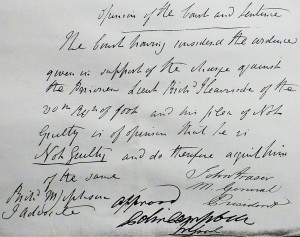
The verdict of the Heaviside Court Martial
On the 27th December two privates of the 30th, John Simpson and William Woodhouse, were arrested for breaking and entering, and stealing stockings and shawls. Private Brian Farrell was later arrested for aiding and abetting. The three men now await trial.
1st Battalion: Trichinopoly
Lieutenant Lewin was given permission by the officer commanding the Southern Division (General Wilkinson) to retire to the Presidency for recovery of health. On the 22nd December Captain Chambers received permission to proceed to Europe.
On the 18th December the court trying Lieutenant Nicholson re-convened. Invited to present his defence, Nicholson requested that his initial statement should be read on his behalf because his health was still uncertain. The court agreed that it should be read by a junior member.
Nicholson’s main arguments related to the long delay between his vist to Major Maxwell, when he was supposed to have said that blood would be shed, and Maxwell reporting the claim to Colonel Vaumorel, a delay of more than nine months. He also denied using the term “Blood must be spilt” or urging the repetition of a duel. He pointed out that the original duel was conducted at the behest of the officers of the 30th, to clear the air between Jackson and Chambers, and it was only when a story emerged that Chambers, rather than Jackson, had apologised that he, Nicholson, became involved.
His next concern was to discredit Lieutenant Barlow, who, he pointed out, had been accused by Maxwell of perjury on another occasion. In his opinion, Maxwell’s delay and Barlow’s unreliability more than answered the first charge.
As for the second charge, he was accused by Lieutenant Sinclair of having challenged him to a duel, but the court martial which would have proved his innocence was abandoned on account of his serious illness. The crucial letter in which he requested an exchange into another regiment belonged to this period. He again acknowledged that the signature was his, but claimed that he had no recollection of signing it. He did claim, however, the Colonel Vaumorel’s subsequent behaviour, in demanding that he should sign the resignation before he received the promised recommendation, demonstrated his enemies’ desire to ruin him. He was, indeed, still desirous of quitting the regiment, but he did not trust Vaumorel.
Finally, he pointed out to the court that he had been held under arrest for thirteen weeks, an excessive amount of time.
From the witnesses he called Nicholson was able to establish that Wilkinson had had some discussion with Maxwell about the time the decision was taken in September to arrest Nicholson, that other officers of the regiment, including Vaumorel, had formerly found not fault in his conduct, and that Lieutenant Sinclair had originally heard the story about blood being spilt from Lieutenant Barlow. Chambers, not surprisingly, supported Nicholson’s claim that nothing had been said about blood being shed.
The following day (19th) several men in the ranks testified on Nicholson’s behalf. Most damning was the evidence of Private Quinn, who maintained that Corporal Cherry had asked him to perjure himself. He had also heard from some other men that Major Maxwell had told Cherry he would soon be promoted sergeant.
On the 20th Nicholson questioned Vaumorel, who maintained that he had completed his side of the agreement, even though on two occasions he did not send the promised recommendation with the letter of resignation to which Nicholson was expected to add his signature. When the President questioned Vaumorel further, he still claimed that he had fulfilled his part of the agreement. At this point Lieutenant Cunningham agreed with Nicholson that the recommendation should have accompanied the resignation letter.
Finally, Maxwell, for the prosecution on the first charge, called several witnesses to establish Barlow’s veracity, claiming that the accusation of perjury had been based on a misunderstanding.
The next day Cunningham, as Judge Advocate, proposed to read the whole proceedings to the court, rather than summarise prosecution and defence. The court then considered their verdict but did not make it public. Instead, the court adjourned sine die. The verdict of the Court Martial is expected in due course.
Depot: Wakefield
Eight recruits have joined, in addition to the eleven men from the militia, and a further six recruits are still with the various recruiting parties.
Private John Blower, a labourer from Shipstone, recently deserted from the depot.
Privates Patrick Hagan and George Batemen have both been discharged in Ireland as unfit for further service.
_______________________________