1st December 1809
2nd Battalion: Gibraltar
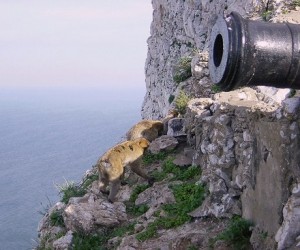
Picture by Allie Caulfield
Captain Bamford, who is believed to have been recruiting in Sleaford, has been ordered to join. His presence will be welcomed because the battalion remains short of experienced companyofficers. The battalion has also received news of the death of Lieutenant Wood, who had been serving with the first battalion in India, although properly belonging to the second. As a result of his death, Ensign Eades has been promoted to lieutenant.
With two recruiting companies now officially established, the battalion have received an order to send a recruiting party to England under the command of Sergeant Darville. Another fourteen men, plus a sergeant and a drummer have been drafted to the first battalion. They embarked for India on the 27th November.
On the 24th November the battalion was inspected by Major General Fraser.
Their strength was given as 35 sergeants, 37 corporals, 17 drummers and 499 privates under arms, and 5 sergeants and 35 privates sick in hospital. (This is a pleasing decrease in the number of sick.) During the last six months, 6 men have died, 3 have been discharged, 10 promoted, and 1 reduced.
The report on the nationalities of the soldiers produced the following information:
Among the sergeants, 31 are English, 2 are Scottish and 18 are Irish. For the corporals, the figures are 36 English, 1 Scottish and 21 Irish. There are 13 English drummers, 1 Scottish and 8 Irish. Of the privates 424 are English, 9 Scottish, 352 Irish and 2 foreigners, one from Canada and the other a young lad (Tomas de Jose) who joined the battalion when it was in Lisbon, earlier in the year. (NB These figures include the depot.)
The relative inexperience of the battalion is demonstrated by the length of service: only 5 men have served more than 21 years; 30 have 14 to 20 years’ service; 72 have served between 7 and 13 years; and 782 under 7 years (of whom 273 have less than 3 years service).
They are also a relatively young battalion: 62 are aged over 40; 224 between 30 and 39; 229 between 25 and 29; and 350 under 25.
The nationality of the officers does not reflect the overall composition of the battalion. There are 18 English officers, 4 Scots and 29 Irish. (4 have their nationality unrecorded.)
Further information will be posted as it becomes available.
1st Battalion: Trichinopoly
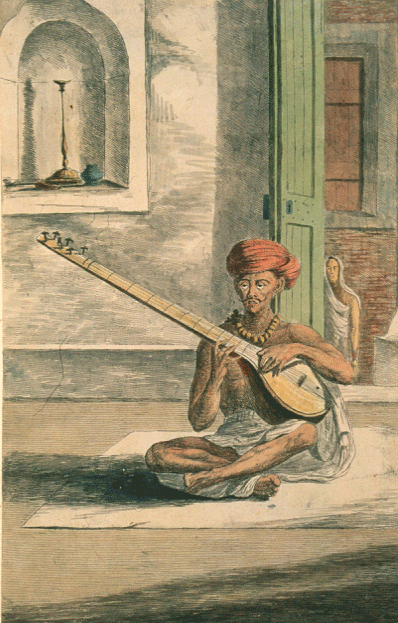
A native playing the sitar
Captain Chambers has been posted absent without leave “until answer arrives from the Commander-in-Chief respecting him”. Although he was assumed to be on his way from Madras for Lieutenant Nicholson’s court martial, which cannot proceed without him, he had asked for leave to return to Europe upon his resignation from the regiment, and it is now unclear just where he is.
The monthly return (25th November) listed 8 officers who were to be transferred from the 2nd to the 1st battalion because of their seniority at their respective ranks. They are all described as “not yet joined”. Because the 2nd battalion is now in a war zone (even though Gibraltar is not likely to be attacked) there is no chance of these officers leaving the junior battalion. Similarly, though, there are an equal number of officers (incuding, for example, Captain Chambers) who should be with the 2nd battalion, but they are required to remain in India.
The 1st battalion is still posting Lieutenant Wood as absent with leave, not knowing that he died on board ship for Europe.
Depot: Wakefield
Contemporary manual of infantry drill, 2nd of three parts
Eleven recruits have joined from the Carlow and Tipperary Militias. These are welcome additions to the ranks because they have already been trained in military drill and manoeuvres.
According to the second battalion’s recent inspection return the “paper” strength of the depot is 1 sergeant, 3 corporals, 3 drummers and 86 privates. The actual strength, including the recruitng parties, is 10 sergeants, 3 corporals, 5 drummers and 37 privates. There is no indication in the returns as to how this discrepancy has arisen.
___________________________________