Children at War
Some thoughts on the experience of children in the Napoleonic Wars
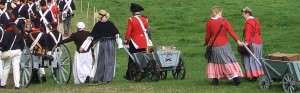
Wherever the army went, the women went too. And where there were women, there were children, from babes in arms to boys old enough to serve in the army, and girls of marriageable age.
Most senior officers were not in favour of the presence of women and children. According to Arthur Trevor of the 33rd: “Soldiers’ wives in Barracks poor things…the evil begins…when these wretched creatures are allowed to crowd into Barracks, with their starving children – some families of 5, 6, 7 and 8 (I have this last in the depot) taking up all the room, bedding, tables, fires of the men.” Trevor suggested it was the women and their broods of children who drove the men to the canteen and the beer shop.
Nevertheless, the presence of children, like their legally married mothers, were acknowledged in monthly returns, although only as numbers, differentiated by gender and by age – under or over ten.
If their life was hard in overcrowded barracks, where a whole family might have the space of one bed, with blankets hung to provide some privacy, how much worse it became when the regiment was on active service. They were allowed a quarter rations; otherwise their parents (which in practical terms meant their mother) would have to provide for them. The journals and letters of the time are full of the tribulations suffered by these yougsters, never more so than on the two terrible retreats, to Corunna in December 1808/January 1809, and from Burgos in October/November 1812.
Rifleman Harris remembered how “Soon after our halt beside the turnip-field the screams of a child near me caught my ear, and drew my attention to one of our women, who was endeavouring to drag along a little boy of about seven or eight years of age. The poor child was apparently completely exhausted, and his legs were failing under him. The mother had occasionally, up to this time, been assisted by some of the men, taking it in turn to help the little fellow on; but now all further appeal was in vain. No man had more strength than was necessary for the support of his own carcass, and the mother could no longer raise the child in her arms, as her reeling pace too plainly showed. Still, however, she continued to drag the child along with her. It was a pitiable sight, and wonderful to behold the efforts the poor woman made to keep the boy amongst us. At last the little fellow had not even strength to cry, but, with mouth wide open, stumbled onwards, until both sank down to rise no more…This was not the only scene I witnessed amongst the women and children during that retreat, Poor creatures!”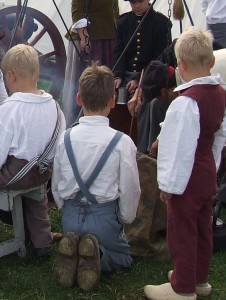
On a happier note, there were many “sons” of regiments who prospered in their inherited military careers. For example, Samuel Bircham was the son of a sergeant in the 30th. Born into the regiment, his moment of glory came in Toulon in 1793. Still in his early twenties and already a sergeant, he successfully brought off the troops from Mt Faron after all the officers had been disabled by wounds. His reward was a commission and he eventually rose to the rank of major. In 1817 he was placed on half pay at the reduction of the regiment, but he then became lieutenant-colonel of a Ceylon regiment.
The three sons of Arthur Poyntz, who himself had risen from the ranks to become quartermaster of the 30th, all served as volunteers until they were old enough to be commissioned. The youngest, James, fought at Fuentes de Onoro aged thirteen, before going to the Royal Military College. Like Bircham, he rose to the rank of major.
Both these examples suggest that regiments cared for their “children”, and two instances poignantly prove the point. Sergeant Edward Laughron was hanged at Mullingar for the murder of his wife, leaving a ten-year-old orphan. This lad, John, was taken under the regimental wing, enlisted as a boy, and finally ended his career as a colour sergeant.
When Elijah Fletcher was killed during the escalade of the San Vincente bastion at Badajoz, he left a motherless child. The casualty returns tell us that his credits were “appropriated together with a liberal subscription from the Officers for the maintenance of his child.”
Some regiments were authorised to enlist a proportion of boys, the 30th being one of them. Such regiments were not to let their numbers rise above ten per company. The boys were to be under sixteen years of age but over five feet tall. They were to be paid 10d a day until they came of age (i.e. sixteen, when they became “lads”). They were also to have “sufficient strength to perform the duties of a soldier…The utmost attention is required to be paid by officers and non-commissioned officers to the messing, cleanliness, and general conduct of these boys, as from their unremitting care and superintendance, the gradual formation of these boys into useful soldiers is alone to be expected…His Royal Highness [the Duke of York] commands me to suggest…the expediency of establishing a regimental school for the instruction of such of them as discover abilities, in the necessary qualifications of reading and writing, with a view to their becoming hereafter, useful and valuable non-commissioned officers.” [Circular from Horse Guards, 1811)
A commentator added: “We presume that officers are also included in this desirable process, of military knowledge; for why should not the young mind of a boy be filled with the pleasing hope and expectation of being able, hereafter, to reach the pinnacle of his profession?” (James, The Regimental Companion Vol.III p.446)
Lieutenant Colonel Hamilton, commanding the 2nd 30th, certainly cared enough about the boys in the battalion to leave them safely in Lisbon.
Regimental schools soon became a useful addition to the regiment, with both the children and some soldiers receiving a basic education from a schoolmaster sergeant who himself received training at Chelsea.
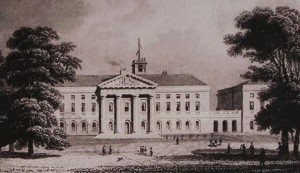
The Royal Military Asylum at Chelsea
Inevitably, the human cost of war was a large number of orphans. The Royal Hibernian Military School was founded in Dublin in 1765, and became the model for the Royal Military Asylum. This was functioning by 1803, having been suggested two years earlier by the Duke of York. Boys – and girls – received a basic education in reading, writing and arithmetic, and were sometimes trained for a trade. The boys were encouraged to join the army, however, and often did so. The children of the Asylum were easily recognisable. The 700 boys wore a red jacket and blue trousers, while the three hundred girls wore red gowns, blue petticoats, white aprons and straw bonnets.
For these fortunate youngsters, war showed a kinder face. Too many, though, who trudged in their parents’ footsteps, were destined to share the fate of the young lad who, as Harris could never forget, perished on the retreat to Corunna.