So you want to be an officer?
SIX EASY STEPS TO A COMMISSION
Imagine you are a healthy and ambitious young man with itchy feet, living in Britain between 1803, after the collapse of the Peace of Amiens, and 1814, before Napoleon’s first abdication. You are also a younger son, with no hope of inheritance, whether it be land, business or trade. What should you do with yourself to save yourself from terminal boredom? Well, there’s always the army. Obviously, you don’t want to serve in the ranks. So how do you go about obtaining a commission?
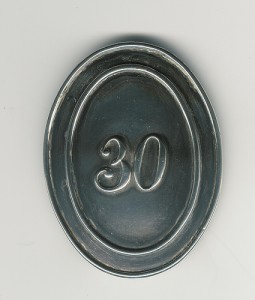
An Officer’s breastplate for the 30th Regiment.
[Picture by kind permission of Q.L.R. Museum, Fulwood Barracks, Preston]
The following list gives you the six options open to you in time of war.
1. Purchase your commission.
In peacetime, this is by far and away the preferred option, and even when Britain is at war, as now, the majority of officers will have bought their commissions. Of course, there is a snag; you need the money for purchase. Assuming, though, that your family have the resources to help you achieve your ambition, for example £400 for an ensigncy in a line regiment, £900 in a Guards regiment, rising to over a thousand pounds for a cornetcy, the process is fairly straightforward. You will need to make an application to the Commander in Chief, via his military secretary. You will also need the support of two men of status and character. The odd general or member of parliament, as used by Benjamin Nicholson when he purchased his commission into the 30th, would prove useful here. No doubt your father will see to this for you. Assuming your name is approved by the Commander in Chief – and as you are a young man of good character, there should be no problem – you will then be added to a register of candidates awaiting available commissions.
To make the process even easier, you could obtain a letter, issued by the adjutant general’s office, from a regimental agent, fill in the appropriate details and return it to the agent, who will then send it to Horse Guards on your behalf.
Now, all you have to do is wait your turn. With so many regiments serving in unhealthy stations like the West Indies and India, and other regiments engaged in campaigns in Europe, particularly in the Peninsula after 1809, you shouldn’t have long too wait.
2. Attend the Royal Miltiary College
If you attend the recently founded Royal Military College at High Wycombe (later transferred to Sandhurst) and complete your studies successfully, you will automatically be commissioned without purchase. Obviously, this requires more effort on your part but you will undoubtedly join your new regiment better prepared for the duties of an officer. In order to enter the RMC you need to be the son of a serving officer or, even better, the son of a deceased military officer. James Poyntz of the 30th was the former (son of the quartermaster with the 1st battalion), and Johnathon Flude, of the same regiment was the latter (son of the late town major of Berwick). Young James was with the 2nd 30th in the Peninsula as a thirteen-year-old volunteer, seeing action at Fuentes d’Onoro, before returning to England, aged fourteen, to begin his studies. He then returned to the same regiment, finally rising to the rank of major. Johnathon served two years with the 2nd 30th, before dying of typhoid fever in Flanders in 1814. In the short period that he served with the battalion he earned himself a reputation for his dedication to duty and his excellence as an officer, so that his death was universally regretted. There is no reason why, with application, you should not emulate the achievement of these two young men.
3. Obtain a commission in the militia
If you come from the appropriate social class, obtaining a commission in the militia will be a mere formality. An application to the the lord lieutenant of your shire should do the business for you. Once you are in the militia and have demonstrated some competence you can transfer to the regulars without purchase although, whatever the rank you may have achieved in your militia unit, you will be commissioned as an ensign in your new regiment. William Stewart, a militia officer, was promoted to lieutenant and appointed adjutant in the second battalion within a year of joining the 30th from the Londonderry Militia. He eventually retired with the rank of major, having served as brigade major in the Peninsula. The same rank was achieved by James Light, who also joined from an Irish militia regiment.
Purefoy Lockwood, from the Tipperary Militia, might have achieved a similar rank but for the tirailleur’s bullet which brought his miliary career to an end at Quatre Bras when he was only twenty-one. He was very lucky to survive and spent the rest of his life wearing a black bandana over the metal plate in his skull.
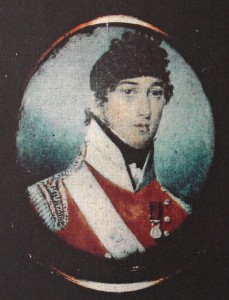

Lieutenant Purefoy Lockwood, 30th Regiment, shown with the black bandana he wore to cover his wound, and the metal plate which was inserted into
his skull after surgery. The plate is inscribed “bombproof”
[Both pictures by kind permission of Clifford Mansfield]
Known ever after as “Bombproof” Lockwood on account of the word engraved on the plate, he served for many years as Captain of Invalids at Kilmainham Hospital.
Before you effect your transfer into the regulars, however, you need to remember that your lifestyle might change dramatically. Although militia regiments were involved in subduing the Irish rebellion of 1798, they have seen no active service since. The lifestyle can be pleasantly social. (See the recently published novel, Pride and Prejudice.
) And there is no danger of being required to serve abroad. If you transfer to the regulars, you could find yourself engaged in action against the French. But perhaps that is what you want. If so, good luck to you!
4. Join as a gentleman volunteer
Because there is a war going on, this is a possible route to a commission if you are a gentleman but do not possess the resources to purchase your commission. You will be serving with a battalion on active service and will become entitled to an ensigncy vacated by death in action, which includes death occasioned by illness while on active service. Suppose, for example, a captain dies or is killed in the Peninsula. The senior lieutenant will be able to step into dead man’s shoes, the senior ensign will progress to a lieutenancy without purchase, and the vacant ensigncy will become yours. Francis Tincombe, an impoverished gentleman from Devon, was able to obtain his commission in the 30th by this route, having served as a volunteer for over a year. A few years later, Edward Neville Macready served as a volunteer in Flanders and was subsequently commissioned into the 30th. Less fortunate was a Mr John Hughes, serving as a volunteer at Villa Muriel, who was posted missing after that action.

The bridge at Villa Muriel
As a volunteer you will march with the men, but you will mess with the officers. Some might find this difficult (as Macready did) but if you are fortunate in your choice of regiment you may find yourself accepted by your fellow officers, as both Tincombe and Macready were in the 30th.
5. Rise from the ranks
Yes, it can be done, even in the caste-ridden British army. Suppose you do not possess the social status to qualify as an officer but you still fancy a period of military service. Or perhaps it’s the only alternative to starvation. It’s unlikely that you will have enlisted with a commission as your ultimate ambition, despite the sweet talking of the recruiting sergeant. But if you prove to be an exceptional soldier either in terms of sustained good conduct (zeal) or distinguished behaviour in action (gallantry) a commission could be your reward. Obviously, you will need to draw attention to yourself as NCO material. And once you have risen to the rank of sergeant, make sure you do nothing that will lead to demotion. If you can make it to quartermaster sergeant or RSM, your chances of a commission are even higher. Eight quartermaster sergeants in the 30th were commissioned, some to quartermaster and then to ensign, some directly to ensign. For example, Robert Daniell was commissioned from QMS to ensign at the request of his commanding officer, Lieutenant Colonel Hamilton and officers of the 2nd 30th. Similarly, the long-serving RSM, David Glass, was commissioned into a Veteran battalion.
Obviously, to be commissioned “in the field” as a result of outstanding conduct in action relies more on chance but the reward is there for those who deserve it. Samuel Bircham, still in his twenties and already an outstanding sergeant, successfully brought men of the 30th safely out of action at Toulon after all the officers had been wounded. For this he was rewarded with a commission, and eventually rose to the rank of lieutenant colonel. The same rank was achieved by Robert Hughes, although he followed a slightly different route. He was commissioned from sergeant into a Portuguese regiment at a time when the Portuguese army was being strengthened by the importation of British officers, and then transferred into the 30th. Nor was he alone in following this particular route.
This may seem the most difficult way of achieving a commission. It is certainly the most protracted. But with about 10% of officers in the British army being promoted sergeants, it is certainly a possibility for the literate and determined recruit.
6. “Without purchase”
If you are the son of a serving officer, or the son of someone who has served as an officer, this remains a possibility. After the collapse of the Peace of Amiens, regiments are adding extra battalions and there aren’t enough “with purchase” candidates to officer them. Nor will the situation improve with the war in the Peninsula. Indeed, so urgent is the need for officers that, even without military connections, you may be able to achieve your commission “without purchase”.
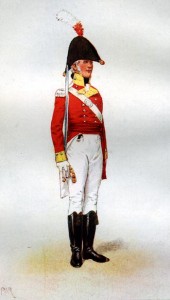
So there you are, six different routes to a commission. But be quick. Once the war is over, there will be fewer vacancies. Battalions will be disbanded (to save money). The death rate will fall. And purchase will once again become the main way to obtain a commission. But then, would you want to serve in a peacetime army?
_______________________________________________